
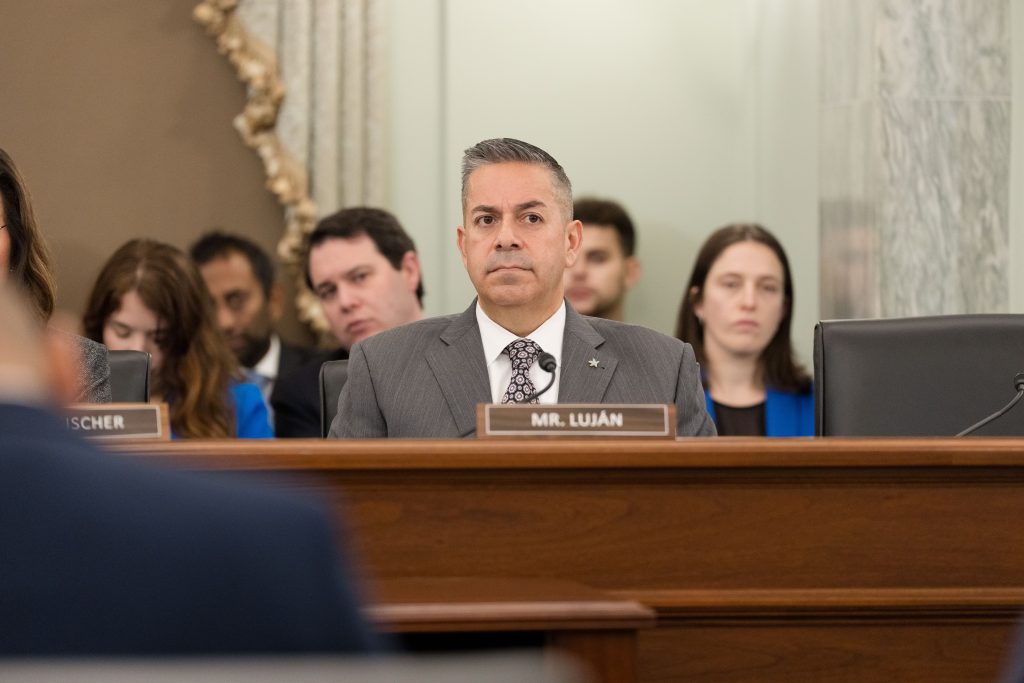
Washington, D.C. – Today, U.S. Senator Ben Ray Luján (D-N.M.), Ranking Member of the Senate Commerce Committee’s Subcommittee on Telecommunications and Media, helped lead a subcommittee hearing titled “Signal Under Siege: Defending America’s Communications Networks.”
With Americans spending more time online, cybercriminals – both domestic and global – are evolving and finding new ways to disrupt, infiltrate, and attack U.S. telecommunications systems. During the hearing, Senator Luján examined how evolving threats and security vulnerabilities are impacting our communications networks and reviewed efforts the federal government can take to safeguard the communications industry. Additionally, Senator Luján raised concerns about actions taken by the Trump administration to dismantle efforts to protect our communications networks from fraud, espionage, and sabotage.
Last year, as Chair of the Subcommittee, Senator Luján convened a hearing on communications networks safety and security in the wake of the Salt Typhoon hacks.
The hearing witnesses included:
- Mr. Robert Mayer, Senior Vice President of Cybersecurity and Innovation, USTelecom—The Broadband Association
- Mr. Daniel Gizinski, President of Satellite and Space Communications Segment, Comtech
- Mr. Jamil N. Jaffer, Founder and Executive Director, National Security Institute at the Antonin Scalia Law School at George Mason University
- Ms. Debra Jordan, Former Chief of the Public Safety and Homeland Security Bureau, Federal Communications Commission
Video of the hearing is available here.
An excerpt of Senator Luján’s opening remarks, as prepared for delivery, are below:
I think every member on this committee can agree that there is nothing more important than keeping our communities and our country safe. That’s why the security of our communications networks is vital.
The networks are the foundation of our daily lives – they carry our phone calls, texts, internet traffic, health information, emergency services, and so much more.
It’s also our responsibility to ensure that foreign actors like China cannot infiltrate our infrastructure or steal Americans’ data.
There is clear evidence that foreign adversaries — including nation-state actors — are escalating their efforts to infiltrate and compromise our networks.
The Salt Typhoon hacks from last year exposed fundamental weaknesses in our telecom infrastructure. That attack breached major carriers, such as Verizon, AT&T, and T-Mobile, and compromised millions of individuals’ data.
This attack also likely represents the largest telecommunications hack in our nation’s history.
About a year ago, we examined this very topic – in this very same committee room. Yet a year later, our communications networks are no more secure. And we can see that it’s not just the major carriers – I’m also concerned that our schools, hospitals, and libraries; our police departments and emergency responders; are all exposed and do not have the resources to defend themselves against foreign adversaries.
I am also extremely concerned that the Federal Communications Commission rushed to dismantle efforts taken under the last administration to verify the security of our networks.
The FCC stripped these protections away — replacing them with voluntary pledges and handshakes from companies whose networks have already proven themselves to be vulnerable to data breaches. To put it plainly, these companies are basically leaving their front doors unlocked after a data break-in, and the FCC has decided to take their word when they promise they’ve installed deadbolts and security cameras.
It is all deeply troubling.
By removing enforceable standards, the FCC is weakening our national security at a time when our communications and digital landscapes are growing like never before.
There is still a lot we don’t know about the damage done by the Salt Typhoon hacks. In fact, President Trump fired the board that was investigating the attack.
###